Gerard's Perspective · Feature
Gerard Grogans and the work of rewriting an inherited life
On the Zach Feldman Show, the coach and author discusses childhood abuse, recurring patterns and the search for a system of personal change.
By The Becoming Times Staff ·
Listen to the full interview
“I realized that I was in a repetitive cycle.”
When Gerard Grogans tried to start a business, write a book or build a coaching programme, he could still hear his father’s verdict: the children were dumb, stupid and would never amount to anything. He had rejected those words, he told Zach Feldman. But rejecting them had not stopped them returning whenever he attempted something new.
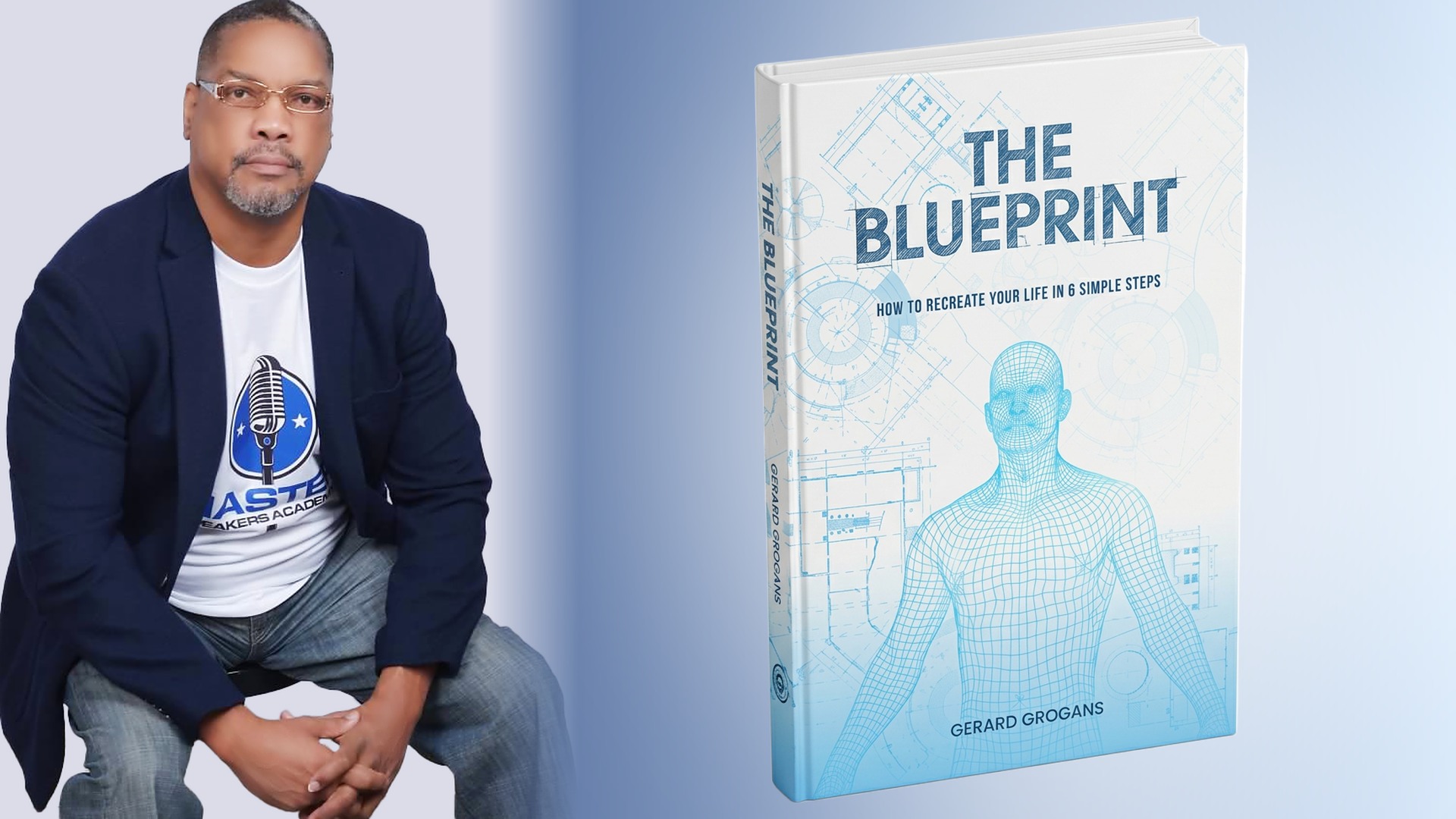
That distance between what he consciously believed and what he felt conditioned to expect sits at the centre of The Blueprint: How to Recreate Your Life in Six Simple Steps. For Grogans, a transformational life and speech development coach, the book grew from an effort to understand why experiences he wanted to leave behind kept shaping his adult life.
Speaking by phone on the Zach Feldman Show on Z Radio Live, he described an abusive childhood, failed relationships and marriages, and a period of reading and study that eventually became a framework he hoped to teach others.
His account was not simply about finding confidence. It was about recognising repetition — and asking how much of the life he was living had been organised around messages he had never chosen.
Recognising the pattern
Grogans traced his turning point to the breakdown of relationships. He began to see that the difficulties were not isolated events: something familiar was recurring across different parts of his life.
“I realized that I was in a repetitive cycle,” he said.
The recognition required an uncomfortable shift in attention. Alongside acknowledging what had happened to him, he began examining his own contribution to the demise of his relationships and the gap between his circumstances and the life he wanted.
He also referred to another traumatic event, without describing it. What mattered to the account he gave Feldman was the decision that followed: he needed to change rather than continue repeating the same patterns.
“I wanna become the best version of myself that I can be.”
That aspiration sent him towards books. He named Tony Robbins, Joe Dispenza and Francine Shapiro among the authors he read, describing hundreds of books on psychology, neuro-linguistic programming, hypnosis and other approaches.
The range of that reading is part of his story of self-education. It does not, by itself, establish that the different approaches offer equivalent answers to trauma. In the interview, Grogans discussed them primarily through the lens of what he believed had helped him understand and change himself.
From reading to a blueprint
The idea that eventually gave his reading a structure was a system: a sequence rather than an accumulation of insights.
Grogans recalled encountering that principle in Robbins’s Awaken the Giant Within. As he remembered it, Robbins compared creating change to baking a cake — combining ingredients in a way that would produce the intended result.
The analogy did not initially help him. “To be honest, man, it didn’t make any sense,” he said.
A later encounter with Brian Tracy’s Maximum Achievement made the concept clearer. Grogans described Tracy’s comparison of a system to the chapters of a book, a step-by-step process. That image helped him organise what he had been studying.
“I just started to write, man,” he said. “I just started to write.”
The book began to take shape from there. Although its title promises six steps, Grogans did not set out a complete, numbered programme during the conversation. Instead, he described a series of underlying questions: who he was, where he was starting, what he wanted and what stood in his way.
His language about change was emphatic. “You have to decide to become someone else,” he said.
In his telling, that meant more than setting a goal. It required examining unprocessed emotions and the experiences he believed were operating beneath his conscious intentions. Self-awareness was a beginning, not the whole task.
Where self-help meets professional help
Feldman pressed Grogans on a practical question: had he considered speaking to a therapist or another professional about what he had experienced?
Grogans answered by discussing the way people can become their own guides through difficulty, then turned to his education. He said he had degrees in psychology, metaphysical psychology and sacred theology. The conversation did not identify the institutions or establish clinical qualifications.
His initial purpose in studying, he said, had been to help himself. Only then could he credibly attempt to help somebody else.
“I can’t sit here and say that I can help someone, you know, recreate their life or change who they are if I haven’t done it for myself,” he said.
When Feldman later asked what resources might help people facing similar experiences, Grogans explicitly included professional support.
“I would definitely suggest hiring a counselor or hiring someone who specializes in mental health or mental trauma,” he said.
He also returned to the authors who had influenced him, mentioning Shapiro’s writing about eye movement desensitisation and reprocessing, and ideas from Dispenza and Robbins about changing habits and emotional states. Those recommendations remained his personal account, rather than a clinical assessment of what any particular listener might need.
Feldman repeatedly stressed his own support for therapy. The exchange placed a useful boundary around the book’s promise: a personal framework for change and professional mental healthcare are not interchangeable.
Success on whose terms?
One of Grogans’s more revealing arguments concerned people who appear to have succeeded. Achievement, he suggested, can coexist with a persistent sense of being unfulfilled.
He described a pattern in which someone builds a life around proving a doubter wrong. The resulting success may be real, but the ambition behind it may still be tethered to an old injury. This was his interpretation of such experiences, not a demonstrated explanation for every high achiever’s dissatisfaction.
“But it wasn’t the life that they wanted to create for themselves,” he said.
That distinction brings the conversation back to the father’s voice he remembered hearing whenever he tried something new. Defying an inherited judgement is not necessarily the same as becoming free of it.
Asked whether he now felt better about what had happened, Grogans said he believed his experiences had enabled him to speak to others approaching despair. He did not offer a detailed account of a finished recovery. Instead, he located meaning in being able to recognise somebody else’s struggle.
“I think that if I didn’t go through the experience that I went through, then I wouldn’t be able to talk about it,” he said.